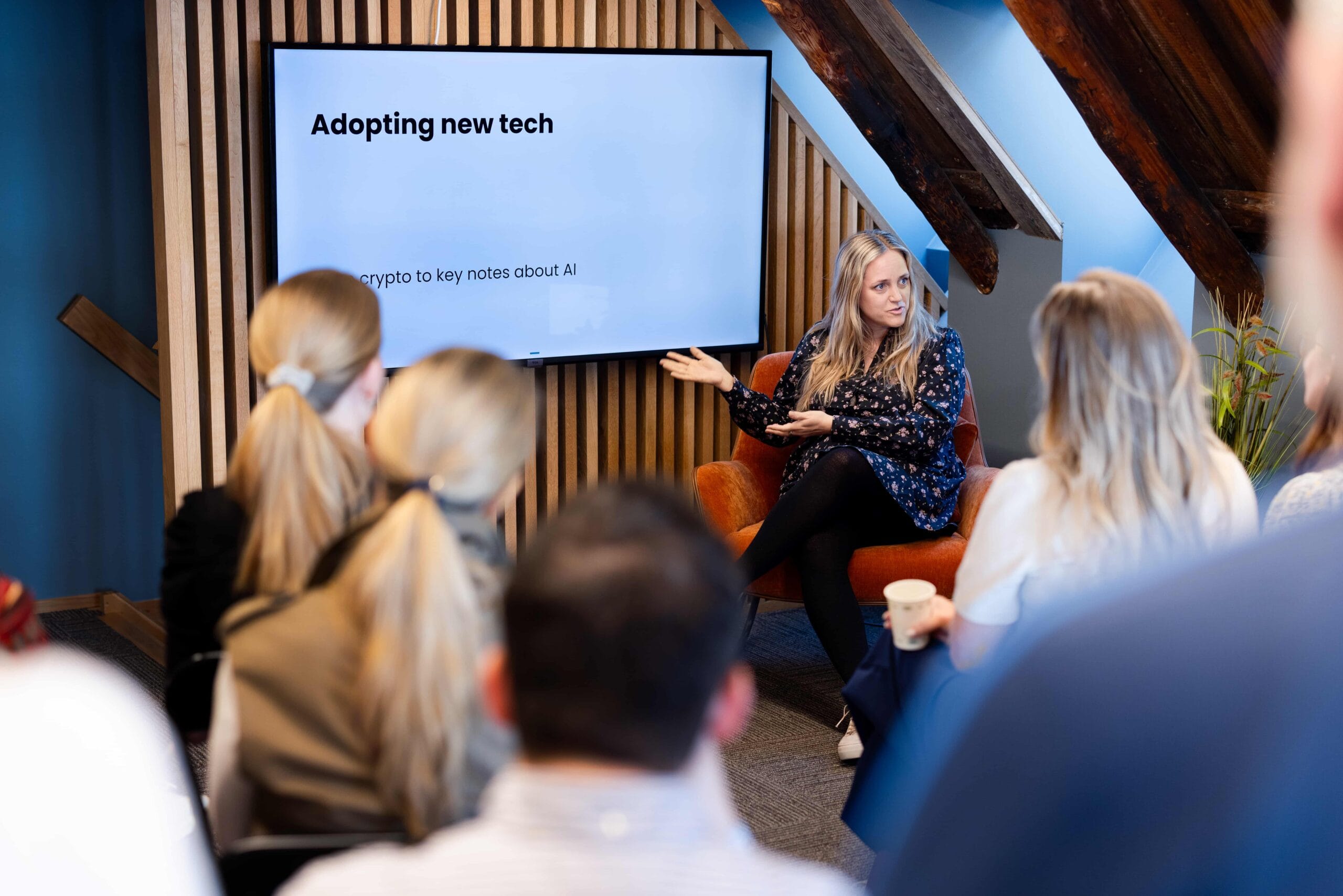
At our latest Morning Focus session, Susanne Todnem — founder, marketing strategist, and advisor to companies ranging from listed corporates to small businesses — gave her practical and witty take on AI in marketing. No hype and no prior coding knowledge required!
Susanne started using AI the way most of us did, with a nudge to try ChatGPT and a vague curiosity that something big was happening.
Jump forward a few years and she now runs her business with a Claude Cowork employee who never takes time off, and Petter Stordalen has talked her out of shutting down her company (she doesn’t know him at all – read on!).
Context beats prompting
Not long ago, the conversation around AI was all about prompt engineering. Susanne says that’s changed.
“Context is more important than prompting. Build your structure and framework. If you build a strong context with the right documents, a clear brief, a well-organised project, you can take that structure with you to any tool, regardless of how the AI landscape shifts. Your framework becomes the asset, not your knowledge of any single platform.”
Treating AI as part of the team
Susanne was honest about the business impact AI has had on her own company. Two years ago, she had three full-time employees. Today she has the same revenue and one Claude Cowork employee, running autonomously in the background while she makes herself a cup of tea.
Recently, she spent 40 days writing down every single task she did in her business – using a good old-fashioned pen and paper. She fed this insight into Claude and asked: what can be automated? What can be outsourced? What can be stopped entirely?
She now integrates AI into her client work. At the start of every month, Claude Cowork produces a full monthly content schedule across five social media platforms and a website – something that would have previously taken her days to produce manually.
It starts with strategy
Susanne made a point that’s easy to overlook: the heavy lifting in AI isn’t the tool, it’s the strategy behind it.
You need to know what problem you’re solving, why it matters, and how you’ll measure success. And while most Norwegian companies are now using AI, most are still in exploration mode. The next step is execution – outsourcing real tasks, not just experimenting.
Build your own Board
One of the more creative use cases Susanne shared is building a personal advisory board of 15 people inside her AI tools. The board includes Oprah Winfrey, Petter Stordalen, a Norwegian financial expert, and others she admires. When she’s facing a difficult business decision (including one moment where she genuinely considered shutting down her company) she asks the board for their perspectives.
AI amplifies expertise
Susanne pushed back on the idea that AI levels the playing field entirely. In her view, domain expertise is what separates good AI output from generic fluff.
The best designs from Claude Design will come from designers, because they know how to direct it. The best video content will come from people who understand video. And for Susanne, whose sharpest skill is writing, Claude Cowork produces better copy because she knows what valuable input and a good output looks like.
That said, she’s clear about where she draws a line: AI hasn’t written a single word of the book she’s working on. Claude knows her tone, her humour, her background, but she wants it to be hers.
Tools for marketers
A few specific recommendations Susanne flagged for marketers:
- Claude + Canva or Claude Design — great combos for content creation
- Wispr Flow — a voice-to-text app that dramatically speeds up workflow
- NotebookLM — turns PDFs into podcast episodes or infographics for learning and content repurposing
- Otter — a transcription tool that captures meetings and conversations, great for turning spoken content into written assets
Giving back
Susanne posed a challenge that went beyond tools and tactics.
AI will save you time and money — the real question is what you do with it. More time for walks, books, and creativity is a good start. But she also floated something more ambitious: if your company saves 20% by replacing external software with something built internally, could 5% of that go to charity, or directly to your employees?
Technology is moving fast. But the decisions about what we do with the time it gives us back are still entirely human.
Follow Project Neon for upcoming Morning Focus events and more refreshing conversations like this one.